
Ordinary Chemistry
A Story About Where Damage Lands

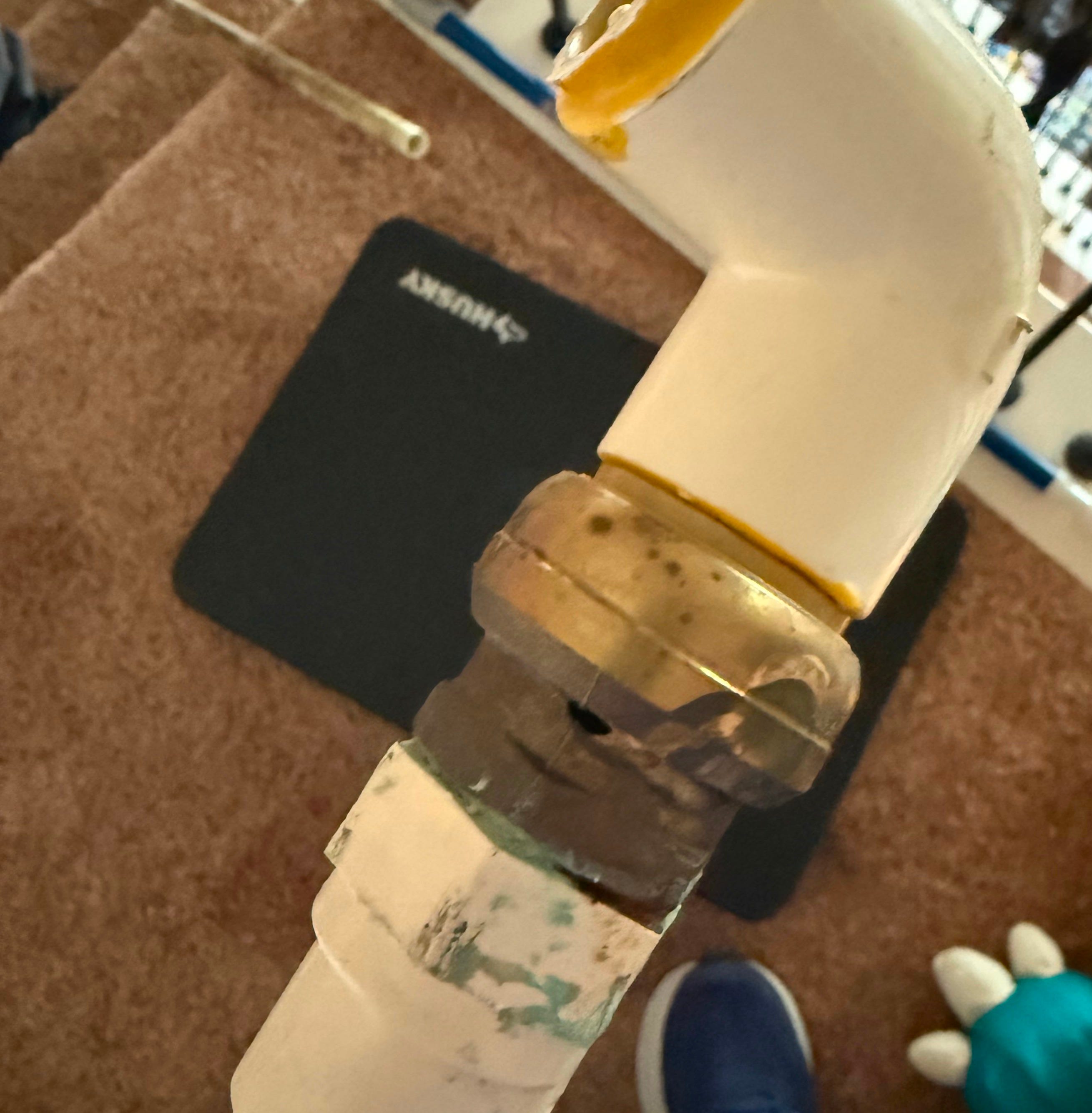
We have a tankless water heater in our attic. It produces condensation, and a CPVC pipe carries that condensation out of the house. The pipe had to turn at one point, and there was a brass coupling just before that, joining two sections of slightly different diameters.
Where the sizes didn’t quite match, water slowed, just a little. Just enough. Condensation is slightly acidic, and slowly, over the course of years, it ate through the metal. When we found it May 21st, the hole was about an eighth of an inch in diameter.
My husband had gotten sick at the end of April — he complained of a sore throat the day after I landed in Oregon. I got sick during my vacation and assumed it was the dog at my friend’s home, or the pollen. When I got home and didn’t get better, I started antibiotics for what seemed like a sinus infection. Then a week into a ten day course, I relapsed, this time with the addition of fever for three days. And as you would expect with sinus trouble, my snoring was terrible — the kind that wakes you up hearing the echo.
The snoring had actually been bad for months. Since before May. Since before Oregon. That detail keeps snagging at me now.
I keep returning to it because it changes the timeline. The story I told myself — the dog, the pollen, the sinus infection, the relapse — all of it was true, and none of it was the source. Every explanation was plausible. Every explanation was local. That’s not misdiagnosis through carelessness. That’s what happens when the actual origin is hidden behind a wall, slowly dissolving something that isn’t visible yet.
We found the hole because my husband found mold in the closet directly beneath the coupling. A 4 foot patch on the ceiling, extending down the upper portion of the wall. The 2x4 under the coupling was completely saturated.
The kind of damage that doesn’t happen overnight is familiar.
This is ordinary chemistry, doing exactly what it does. The same conditions that others move through without incident accumulate differently in a neurodivergent nervous system — not because of catastrophic failure, but because of where we’re positioned in the system. Damage doesn’t land randomly. It concentrates at the coupling, the place where two things of different sizes are forced to connect.
The hole started on the inside. What looks like sudden crisis is accumulated damage finally breaking through to the surface — a timeline that was always there, just illegible. And the signals were there too, sent with increasing urgency, each one answered with a closer, more plausible explanation than the actual source.
This is how systems fail. Not with a single catastrophic event, but with ordinary chemistry running uninterrupted, until the damage breaks through to the visible surface.
Neurodivergent people rarely have the luxury of missing this lesson. We live at the misfit joint, where the chemistry is most concentrated and the damage lands first.
NeuroCourage is a neurodivergent discord community where we support one another and work to create a more inclusive world. Learn more here:
